A neuroaffirming guide to navigating Halloween
No Tricks Just Support
Before we begin
Before we begin, we want to be really clear about one thing: there is no right way to do Halloween. It is not a test of flexibility, bravery or good parenting. Your child’s version does not need to look like anyone else’s.
Halloween can be brilliant. It can also be noisy, visually busy, unpredictable, socially demanding and full of unfamiliar sensations. A child might love pumpkins but dislike costumes, want to collect sweets but find doorbells painful, or feel excited in the morning and completely finished by late afternoon. All of those experiences are valid.
Sensory differences can involve sound, light, smell, taste, touch, movement, body awareness and internal sensations. They may be enjoyable, uncomfortable or painful, and they can vary with tiredness, stress, health and the environment.1
Research led by autistic adults also shows that public places are experienced as combinations of interacting sensory and social demands, rather than as one isolated trigger. Control, predictability, escape options and other people’s understanding can all change how manageable a place feels.2
Start with your child, not the tradition
Before making a plan, start with the part your child actually wants. They may want to dress up, give out sweets, visit one familiar neighbour, walk past the decorations or skip Halloween this year. Use speech, pictures, objects, written choices, signing, AAC or whatever communication is most accessible. A broad question such as ‘Do you want to do Halloween?’ can hide many smaller decisions.
It may help to think of participation as a ladder, with plenty of places to pause. It might look like:
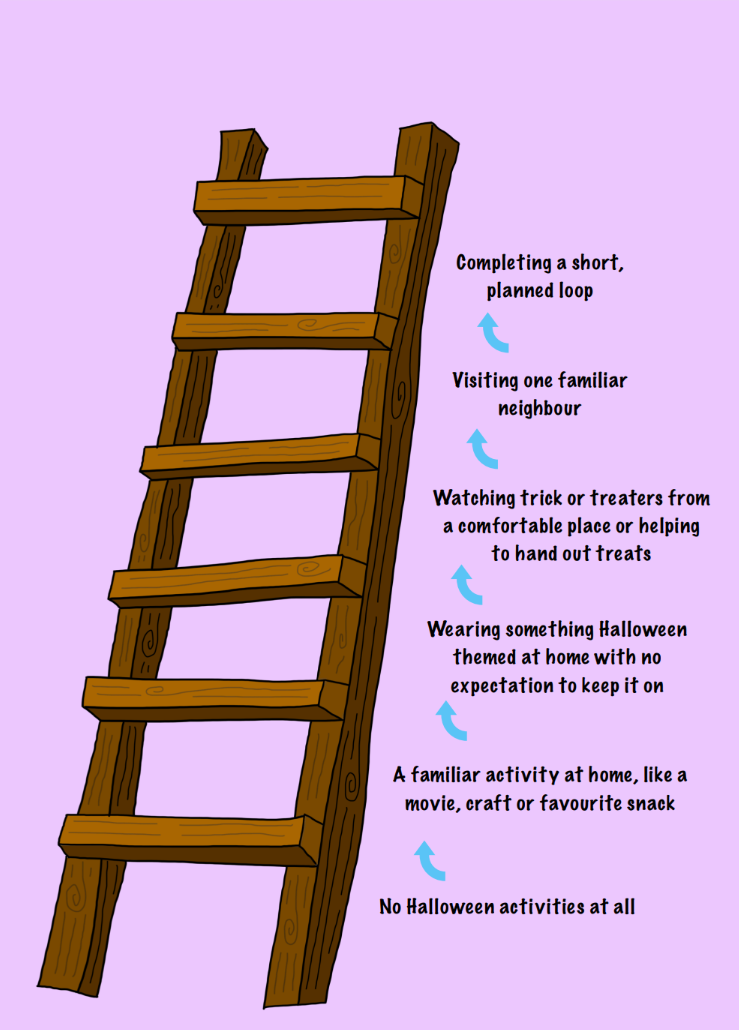
This is not a ladder your child has to climb. There is no ‘next level’, and they can change their mind. Make the exit plan just as clear as the activity plan: where will you go, what signal means ‘finished’, and who will respond? Knowing they can leave often makes trying something feel safer.
Make a plan and let the plan change
Halloween has some very unusual rules when you stop and think about it. People wear disguises, knock on doors, repeat the same phrase and receive food from neighbours. Talking through what might happen can reduce uncertainty. The important bit is remembering that a plan is support, not a promise.
A few things that can help:
- show photos of the route, the houses or the decorations you expect to see
- make a simple now and next plan, visual timetable or short sensory story
- practise at your own front door or with one trusted neighbour
- agree the maximum number of houses while making it clear that stopping earlier is always allowed
- identify a quiet place, the quickest route home and a familiar adult who will leave immediately when asked
- schedule food, drink, toilet and movement breaks before the child becomes depleted
UK NHS guidance recommends clear language, visual supports, extra processing time, advance preparation and meaningful choices. It also notes that busy sensory environments can make communication harder.3
Social and sensory stories can help some children understand what may happen and what they can do, making an unfamiliar situation more predictable.4
Keep these tools descriptive rather than prescriptive. ‘Some houses may have flashing lights, and I can walk past’ leaves room for choice. ‘I will stay calm and say thank you at every house’ can turn a support into another demand.
Noise, lights, and decorations can be a lot
Doorbells, excited shouting, music, animatronic decorations, flashing lights, fog machines, strong smells and crowded pavements can all arrive at once. A decoration that seems funny to one person may feel startling or painful to another. Some children will seek out the movement, colour and sound. Others will want none of it. Neither response is wrong.
At home
- Put decorations up gradually, if that helps, and let your child choose where they go. Keep at least one familiar room decoration free.
- Switch off motion sensors, sudden sounds and flashing modes. If your child enjoys them, let them activate the decoration so the surprise is no longer a surprise.
- Use battery-operated lights rather than scented candles or strong room fragrances.
- If knocks and doorbells are difficult, disconnect or mute the bell, silence smart doorbell alerts, and put a polite no trick-or-treaters sign in the window. You do not have to keep answering the door.
- If you want to give out treats without repeated interruptions, one adult could sit near the doorway for a short, planned time while your child stays elsewhere with another trusted adult.
Out and about
- Choose a familiar route and try going earlier in your local trick-or-treating period, before the streets become busier.
- Try a small loop with one or two known houses. One comfortable doorstep can be a complete Halloween; the number of houses doesn’t measure success.
- Bring the child’s usual sensory tools, such as ear defenders, noise-reducing headphones or earplugs like Loops, sunglasses, a cap, a fidget, a chew, or a familiar comfort item.
- Use hearing protection in a way that still allows safe awareness of traffic and instructions. Close adult supervision is particularly important near roads.
- Walk past houses with loud or moving decorations. You never have to approach every decorated home.
- Have transport, keys and the route home ready so leaving does not involve negotiation or a long wait.
The National Autistic Society recommends practical changes such as reducing light and background noise, identifying quieter times and routes, providing headphones or ear defenders, preparing maps and making a quiet space available.5
Communication might look different
Trick or treating carries many hidden communication demands: approaching someone unfamiliar, timing a greeting, answering questions about a costume, choosing an item, and saying thank you. Speech may become less available when a child is excited, anxious, cold, tired or overloaded. That is not rudeness or ingratitude. It is communication changing under pressure.
You can make the interaction easier by:
- avoiding pressure to make eye contact, speak on demand or explain a difference
- using a card or badge that says ‘Trick or treat please’, ‘Thank you’ or ‘I communicate differently’
- keeping AAC, symbols or a phone-based communication system accessible rather than hidden under a costume
- letting a trusted adult speak when the child wants them to
- agreeing on a simple exit signal, such as showing a card, tapping twice, signing ‘finished’ or sending a message
- allowing time to process a question before repeating or rephrasing it
If your child does not say ‘thank you’, you can thank the neighbour without turning the moment into a lesson. Communication support should protect dignity and access. Taking part should never depend on performing the expected social script.
Costumes, masks and face paint are all optional
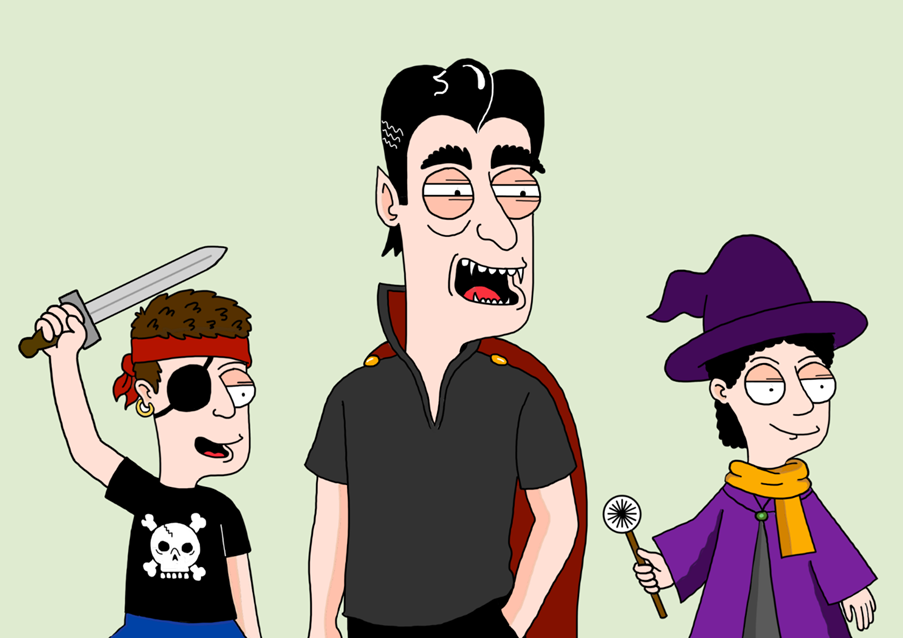
A costume is optional. Familiar clothes, pyjamas, a Halloween T-shirt, a hat, a decorated bag or a favourite prop all count. If your child wants a fuller costume, try it before the day and notice what feels scratchy, tight, hot, heavy, smelly or difficult to move in. Remove tags, use a familiar base layer and keep ordinary clothes ready. This is about finding out what works, not teaching a child to push through discomfort.
Research with autistic adults shows how fabric, seams, fit, pressure, and temperature can influence comfort, concentration, anxiety, and participation.6
Masks and face coverings may restrict vision, feel hot or damp, change how sound is heard and make communication harder. They can also make familiar people more difficult to recognise. Your child may prefer to carry a mask, wear it briefly, choose a half mask or avoid it completely. If a familiar adult is dressing up, show the costume first and put the mask on in front of the child. Take it off whenever they need reassurance or clearer communication.
Face paint can feel wet, cold, sticky or tight as it dries, and removing it can be the hardest part. Offer real alternatives: a small design on the hand or cheek, a temporary tattoo, make-up on a mask, or no paint at all. If you choose face paint, use a product intended for skin, follow its age and safety instructions, avoid broken or irritated skin, and stop if the skin becomes sore. Consent is ongoing. Wanting the design at 3 pm does not mean it has to stay on all evening.
A quick UK safety check
NICE guidance asks services supporting autistic children and young people to consider individual sensory sensitivities and adjust lighting, noise, colours and processes. The same principle is useful here: make the environment fit the person wherever possible.7
Alongside sensory comfort, it is worth checking the practical safety of the plan:
Buy children’s fancy-dress costumes from a trusted seller and check the labelling, safety warnings, seller details and UKCA or CE mark.
Avoid long cords, trailing fabric and masks that restrict vision. Make sure footwear is secure and the child can move comfortably.
Keep all costumes away from candles, tea lights, sparklers, fireworks and other flames. Use battery-operated candles or glow sticks instead.
Add reflective tape or a light if the costume is dark, carry a torch and stay in well-lit areas.
Young children should remain with an adult. Visit homes that are clearly welcoming trick-or-treaters, and respect no trick-or-treat signs.
In 2024, the Office for Product Safety and Standards reported that more than 80 per cent of 128 targeted costumes for children under seven failed at least one basic test covering flammability, cords or labelling. The sample targeted products thought more likely to be risky, so it should not be treated as an estimate for all costumes; it does support buying carefully.8
London Fire Brigade advises keeping fancy dress away from flames, using battery-operated candles or glow sticks, checking UKCA or CE marking and considering reflective tape after dark.9
UK police guidance also recommends adult accompaniment for young children, well-lit routes, visible clothing, clear vision through masks and respect for homes displaying a no trick or treat sign.10
Coming home counts too
The evening does not necessarily end when the front door closes. Your child’s nervous system may still be processing everything that happened. Keep the return home low demand. Offer familiar food and drink, a warm bath or no bath, movement, quiet, dim lighting, favourite media or time alone, depending on what usually helps. No need for an immediate debrief if talking feels like one more demand.
Come back to it later, using your child’s preferred communication. What would they keep, change or leave out next time? Notice the self-advocacy as well as the fun. Removing a mask, walking past a noisy house, using an exit card, or deciding to stay home all show that a child understands and can communicate what their nervous system needs. That matters.
The bit we really want you to remember
Halloween is an invitation, not an obligation. A neuroaffirming plan is not about helping a child tolerate the same celebration as everyone else. It is about creating enough safety and flexibility for them to choose what Halloween means to them. That might be a costume and a busy street. It might be one familiar doorstep. It might be a film under a blanket with the doorbell switched off. Choosing not to take part is valid too.
And we think that is the point: the celebration should fit the child, not the other way round.
From all of us at Onyx Therapy. We see you, we value you, and we walk this journey with you.
Evidence note
Limited research tests specific Halloween strategies. The recommendations in this guide apply current UK clinical and safety guidance alongside research on autistic sensory experiences, clothing and public spaces. Adapt them to the individual rather than use them as a fixed programme.